
GENERAL REPORT
INVESTMENT REVIEW
(Note: Only limited commentary is given for listed companies seeing that the information is generally available. The unlisted investments are dealt with in more detail.)TOBACCO INTERESTS
CONTRIBUTION TO HEADLINE EARNINGS
 |
|
|
| 2007 | 2006 | |
| R million | R million | |
| R&R Holdings | 2 964 | 2 369 |
R&R Holdings
Remgro’s interest in British American Tobacco Plc (BAT) is represented by its one-third holding of the ordinary shares and all of the “2005” participation securities issued by R&R. This gives Remgro an effective interest of 10.4% in BAT at 31 March 2007. The other two-thirds of the ordinary share capital of R&R is held by Compagnie Financière Richemont SA (Richemont).There was no change in the number of BAT shares held by R&R. However, due to the positive effect of BAT’s continuing share buy-back programme, R&R’s interest in BAT increased to 29.4% at 31 March 2007 (2006: 28.9%).
R&R, Remgro, Richemont and BAT are parties to a Standstill Agreement (the agreement) originally entered into at the time of the merger of Rothmans International and BAT in 1999. Under the terms of this agreement, BAT is not permitted to continue with its share buy-back programme without R&R’s, Remgro’s and Richemont’s consent once their combined interest reaches 30%. At this level, the London Takeover Code would normally require that a cash offer be made for the shares in BAT that R&R does not already own. The agreement therefore protected R&R and its shareholders from the obligation to make a compulsory bid for BAT.
On 1 March 2007 BAT announced that it had sought R&R’s, Remgro’s and Richemont’s consent to allow it to continue with its share buy-back programme, notwithstanding that it believes that the 30% limit will be reached within the next 12 to 15 months. To preclude any obligation on R&R, Remgro and Richemont to make a cash bid for those shares that they do not already own, BAT proposed to obtain approval from its independent shareholders for a waiver under the terms of the London Takeover Code.
R&R, Remgro and Richemont agreed to the proposals made by BAT. In return for giving their consent, they asked for and obtained a commitment from BAT that, if so requested, it will seek to obtain a secondary listing for its ordinary shares on the JSE Limited, subject to all regulatory approvals being obtained. On 26 April 2007 the independent shareholders approved the proposals made by BAT and the waiver under the terms of the London Takeover Code.
R&R’s share of BAT’s earnings for the twelve months to 31 March 2007 is based on BAT’s results for the year ended 31 December 2006 plus the results for the quarter to 31 March 2007 less the results for the quarter to 31 March 2006.
Remgro’s share of R&R’s headline earnings consists of 35.46% of R&R’s share of the attributable profit of BAT and its share of R&R’s non-BAT profit (this includes income attributable to its investment in the “2006” participation securities issued by R&R during March 2006).
|
|
|
| 2007 | 2006 | |
| £ million | £ million | |
| Attributable profit of BAT before capital and non-recurring items | 2 077 | 1 942 |
| R&R’s share of the attributable profit of BAT: | ||
| – 29.06% to 29.40% (2006: 28.56% to 28.89%) | 607 | 558 |
| R&R’s non-BAT income | 9 | 29 |
| R&R’s headline earnings for the year ended 31 March | 616 | 587 |
| Remgro’s share thereof: | ||
| – 35.46% of R&R’s share of the attributable profit of BAT | 215 | 198 |
| – portion of R&R’s non-BAT income | 8 | 10 |
| 223 | 208 | |
| R million | R million | |
| Translated at an average R/£ rate of 13.2898 (2006: 11.4050) | 2 964 | 2 369 |
The following commentary is based on BAT’s annual report for the year ended 31 December 2006.
BAT’s adjusted, diluted earnings per share, a good indicator of its underlying performance, grew by 10% to 98.12 pence per share. This increase was the result of the improved underlying operating performance from both subsidiaries and associates, together with a lower effective tax rate and the benefit of the share buy-back programme, which more than offset the impact of higher net finance costs and minorities.
BAT cigarette sales volumes from subsidiaries for the year ended 31 December 2006 increased by 2% to 689 billion on both a reported and a ‘like-for-like’ basis. Net revenues rose by 5% on both an actual and ‘like-for-like’ basis. This volume and revenue growth was achieved across a broad spread of markets. The four global ‘drive brands’ (Kent, Dunhill, Lucky Strike and Pall Mall) continued their impressive performance and achieved overall volume growth of 17%. These brands now represent over 21% of BAT’s volumes from subsidiaries, while international brands as a whole account for 40% of the total.
BAT’s profit from operations was 8% higher at £2 622 million or 7% higher on a ‘like-for-like’ basis, with Asia-Pacific, Latin America and the Africa and Middle East regions contributing to these results.
In Europe, profit at £781 million was slightly lower mainly as a result of very competitive trading conditions in a number of markets and the inclusion in the comparative period of a one-off benefitin Italy. Excluding this benefit, profit increased by £9 million, with strong growth from Russia, Hungary, Italy and France, largely offset by declines in Spain, Poland, Germany, the Netherlands and Ukraine. Regional volumes on a ‘like-for-like’ basis were 2% higher at 248 billion, with growth in Russia, France, Spain and Hungary partly offset by declines in Ukraine, Italy and Germany.
In Asia-Pacific, regional profit increased by £85 million to £616 million, mainly attributable to good performances in Australasia, Malaysia, South Korea and Pakistan. Volumes at 142 billion were 4% higher as strong increases in Pakistan, Bangladesh, South Korea and Vietnam were partially offset by declines in Malaysia and Indonesia.
Profit in Latin America increased by £81 million to £611 million due to good performances across the region, coupled with a stronger average exchange rate in Brazil. Volumes grew in many of the markets which led to an overall increase of 2% to 153 billion.
Profit in the Africa and Middle East region grew by £34 million to £468 million, mainly driven by South Africa, Nigeria, the Middle East and Egypt. Volumes were slightly higher at 103 billion, as a result of Nigeria, Egypt and the Middle East, partially offset by decreases in Turkey.
The profit from the America-Pacific region decreased by £12 million to £424 million, while volumes were down 3% to 44 billion sticks. The increases in profit and volumes from Japan were more than offset by lower contributions from Canada.
BAT’s associated companies grew their volumes by 4% to 241 billion sticks. BAT’s share of the post-tax results amounted to £431 million. Excluding exceptional items, the share of the post-tax results of associates, increased by £38 million to £427 million, mainly from Reynolds American and ITC. The contribution from Reynolds American, excluding brand impairment charges and the benefit from the favourable resolution of certain tax matters in both years as well as other exceptional charges in 2005, was £18 million higher at £285 million. This was mainly due to improved pricing and cost reductions, partially offset by lower volumes. The contribution from ITC, BAT’s associate in India, increased by £11 million to £91 million.
FINANCIAL SERVICES
CONTRIBUTION TO HEADLINE EARNINGS

Both FirstRand Limited and RMB Holdings Limited have June year-ends and their results for the twelve months ended 31 December have therefore been equity accounted.
FirstRand
FirstRand’s contribution to headline earnings shown above excludes the indirect contribution of FirstRand through Remgro’s interest in RMBH.For the latest reported six months ended 31 December 2006, FirstRand’s headline earnings increased by 26% to R4 569 million (2005: R3 636 million). These results were achieved in a favourable economic environment that provided strong organic growth opportunities, particularly for the FirstRand Banking group.
RMBH
For the six months ended 31 December 2006, 86.9% (2005: 82.7%) of RMBH’s headline earnings was from FirstRand, while its other interests contributed 13.1% (2005: 17.3%).RMBH’s other interests include RMB Structured Insurance Limited, OUTsurance Limited and Glenrand M.I.B. Limited.
OUTsurance posted excellent results for the six months ended 31 December 2006. Net earned premium income exceeded R1.3 billion, reflecting a 27% increase due to strong organic growth in both personal lines and business lines, as well as continued efficiency gains. OUTsurance’s headline earnings for the six-month period increased by 18%. RMB Structured Insurance achieved muted growth in headline earnings of 7% while Glenrand M.I.B. reported headline earnings ofR3.6 million (2005: R9 million) in challenging market circumstances.
INDUSTRIAL INTERESTS
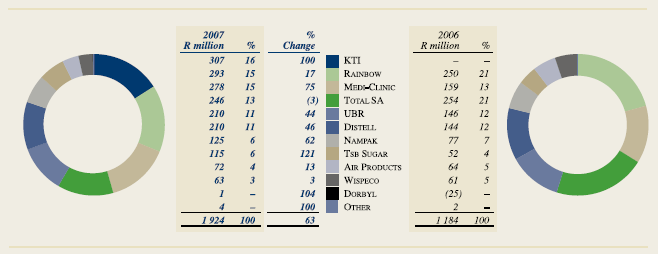
CONTRIBUTION TO HEADLINE EARNINGS
Kagiso
Kagiso Trust Investments (Pty) Limited is a BEE controlled investment holding company. Its investments are predominantly in the financial services, media and other industrial sectors. Its two largest investments, by value, are in Metropolitan Holdings Limited (MHL) and Kagiso Media Limited.KTI posted strong results for the six months ended 31 December 2006, with headline earnings of R625.9 million compared to R473.5 million for the full year ended June 2006.
Included in the earnings are profits realised on the sale of equity stakes in Alstom and Norman Bissett and Associates (NBA), which were held through Kagiso Ventures Private Equity Fund I. It should be noted that KTI has subsequently reinvested in both Alstom and NBA via Kagiso Strategic Investments II.
In October 2006, KTI acquired 7.5% of Macsteel as part of a broader BEE consortium.
In addition, unrealised fair value gains of R302 million, which are included in the headline earnings, were achieved on the investment in MHL.
KTI exercised its option to acquire an interest in the FirstRand Empowerment Trust in August 2006. This resulted in acquisition profits of R81 million, which are also included in headline earnings.
Rainbow
Rainbow Chicken Limited’s headline earnings increased by 19.2%, from R400.3 million to R477.0 million, and by 13.7% excluding a non-recurring taxation benefit.Rainbow’s revenue increased by 15.3% and chicken revenue by 13%. Rainbow’s average price realisation growth of 8% resulted from an improved product mix. Overall chicken volumes increased by 5%, with encouraging growth in sales to the Quick Service Restaurant sector and targeted customers and brands.
The macro-economic environment remained positive during the year, despite increasing inflation and interest rates, and consumer demand remained strong. However, it is expected that the full impact of the interest rate hikes will only be felt in coming months.
Epol is a critical element in Rainbow’s overall cost chain. It has performed well during the year, with improved capacity utilisation through higher external volumes. The raw material procurement strategy has enabled Epol to be price competitive despite inflationary pressures. The significantly higher maize prices will, however, be felt in feed and chicken prices in the new year, which will translate into profit margin compression in the 2008 financial year.
The local chicken industry remains on high alert for avian influenza. Rainbow and the local industry at large, through the Southern African Poultry Association and in co-operation with the National Department of Agriculture, have focused on prevention through increased biosecurity and stepped-up surveillance and monitoring of flock health.
Rainbow’s strong performance is due to a number of strategic initiatives that have increased chicken volumes in targeted customer and branded products and the building of strategic partnerships with key customers, optimising route to market opportunities and product mix.
Medi-Clinic
Medi-Clinic Corporation Limited’s turnover increased by 14% to R5 364 million (2006: R4 723 million) for the year under review, while headline earnings (excluding the STC charge and BEE share-based payment cost) increased by 5% to R581 million (2006: R553 million).On 27 March 2007, the group’s acquisition of a controlling share (50% plus 1 share) in Emirates Healthcare Holdings Limited became unconditional. Emirates Healthcare owns and operates the Welcare Hospital (120 beds) and has commenced construction of the 210-bed City Hospital. This hospital should be operational at the end of 2007. Emirates Healthcare also has the right to develop other hospitals and clinics. This will make Emirates Healthcare the largest healthcare provider in Dubai. Due to the acquisition just before year-end none of Emirates Healthcare’s operating results were included in Medi-Clinic’s income.
Local acquisitions during the year under review included a 49.9% interest in the 190-bed Wits Donald Gordan Medical Centre, a 100% interest in the Legae Private Hospital (137 beds), as well as a 51% interest in the 200-bed Protector Group. Excluding the capacity increase, Medi-Clinic’s turnover increased by 11%, partly due to an increase in both in-patient-bed-days and average income per bed-day as well as a slight change in the case profile of patients treated.
Total South Africa – Unlisted
Total South Africa (Pty) Limited reported excellent results for the year to 31 December 2006 due to increased retail market share and improved margins.The market share of main fuels stood at 14.7% at the end of 2006 (2005: 14.6%). Whilst retail market share continued to grow during 2006, Commercial & Specialities continued its focus on consolidating customer profitability. In 2006, after the launch of the Clean Fuel 1, the Natref refinery experienced a few unplanned shutdowns which resulted in production being lower than expected. Natref is currently having planned maintenance and improvements resulting in a 50-days shutdown. After this operation the production rate is expected to increase.
The company again maintained a high level of investment in its marketing activities during the year. Safety remained a key focus area as part of the overall Total group emphasis on health, safety, environment and quality matters.
Unilever Bestfoods Robertsons (Holdings) LLC (UBR) – Unlisted
The UBR venture covers the territories of Southern Africa and Israel and manufactures and markets an extensive range of food products. It enjoys market leadership in most of the major categories. Israel
The general economic climate in Israel is healthy, with growth in GDP of around 5%, interest rates at historically low levels (3.75%) and the shekel strengthening steadily against major currencies, notably the US dollar. This benign economic environment has been maintained despite the continuing political tensions within the region and the worsening crisis in nearby Gaza. Prices in the economy in general remain stable, with minor deflation over recent months. In the food sector price pressure from competing retailers remains a key feature, with levels of promotional activity continuing to rise steadily.
Turnover in shekel, for the twelve months ended 31 March 2007, increased by 3.5% compared with the previous period. This increase comprised a 2.4% increase in the professional market sector and a 4.0% increase in the retail sector.
Gross margins increased by 2.6% against the previous period. This was driven by a substantial improvement in sales mix, with high-margin cereal sales growing strongly, and by price increases taken in the Dressings and Margarine categories. Cost savings were also effected in line with plans, particularly in respect of distribution costs.
Indirect costs decreased by R25.6 million against the previous period due primarily to the effect of a restructuring programme completed in March 2007. This saw a significant reduction in employees through the period from 2005 to March 2007, but also brought benefits in respect of business simplification and process improvement.
South Africa
2006/2007 was the second year of the Path to Vitality 2010 Strategy. Volume growth in the retail business was 6%, in line with the strategic intent to move volume growth to a sustainable 5-6%. Market shares increased in most categories, particularly in regular soup, stock cubes and herbs and spices, while remaining flat in tea.
Turnover increased by 10.3%. This was driven by a good performance in Savoury & Dressings (S&D) and Cooking with key launches of Rama/Flora and Knorr delivering positive results. Retail turnover is 11.3% higher than in 2006, reflecting strong volume growth across the range in the latter half of 2006. The growth was driven mainly by new product launches and brand specific activities, partly offset by lower growth in the March 2007 quarter due to competitor pricing in tea and the lack of pre-price increase buy-in on S&D.
Interest on shareholder loans decreased due to the partial repayment of loan capital, Remgro’s portion thereof being R164 million.
UBR’s contribution to Remgro’s headline earnings is made up as follows:
|
|
|
| 2007 | 2006 | |
| R million | R million | |
| Earnings before capital and non-recurring items | ||
| – South Africa | 162 | 108 |
| – Israel | 51 | 18 |
| 213 | 126 | |
| Less: Capital and non-recurring items charged against headline earnings | (17) | (1) |
| Headline earnings | 196 | 125 |
| Interest on shareholder’s loan after taxation | 14 | 21 |
| Contribution to headline earnings | 210 | 146 |
Distell
Distell Group Limited’s contribution to Remgro’s headline earnings relates to its results for the twelve months ended 31 December 2006.For the latest reported six-month period ended 31 December 2006, Distell’s turnover grew by 16.6% to R4.3 billion on a sales volume increase of 11.0%. Sales volume in the domestic market increased by 11.9%. International sales volume, excluding Africa, grew by 3.3%, resulting in an increase of 27.5% in international turnover. Turnover derived from African countries increased by 16.3% on sales volume growth of 10.5%.
The increase of 30.2% to R460 million in Distell’s headline earnings for the six-month period ended 31 December 2006, excluding the BEE expense of the previous year, was due to increased turnover resulting from brand marketing and pricing strategies.
Nampak
Nampak Limited’s contribution to Remgro’s headline earnings relates to its results for the twelve months to 31 March 2007.Nampak recently reported an increase in headline earnings per share of 6.2% to 87.6 cents (2006: 82.5 cents) for the six months ended 31 March 2007. However, earnings declined by 3.4% to R462.2 million from R478.3 million.
Revenue increased by 11%, boosted by good volume growth in South Africa. Although the profit margin increased, operating profit decreased by 1.5% to R781 million.
Tsb Sugar – Unlisted
Tsb Sugar Holdings (Pty) Limited is primarily involved in cane growing and the production, transport and marketing of refined and brown sugar and animal feed. The main area of operation is the Nkomazi region in the Mpumalanga Lowveld. Sugar products are sold under the well-established Selati brand. The Selati brand enjoys market leadership in its target market (Gauteng, Mpumalanga, North West and Limpopo), while the recent expansion into other geographic areas has also been very successful. Tsb Sugar’s two sugar mills are situated near Malelane and Komatipoort. Tsb Sugar also holds a 27.03% shareholding in Royal Swaziland Sugar Corporation Limited, a company that owns and operates two sugar mills. In addition, the company holds an effective shareholding of 63.5% in Mananga Sugar Packers – a sugar packaging and marketing company based in Swaziland which markets sugar under the First brand in Swaziland as well as in South Africa.The South African sugar industry’s production decreased by 10.8% in 2006/2007 due to climatic conditions. Tsb Sugar’s sugar production decreased by only 7.7%. This was due to the favourable climatic conditions in the Tsb Sugar water catchment areas and the subsequent increase in irrigation water. The effect of a smaller harvest was offset by the increase in the world sugar price and together with a weaker rand, had a positive effect on the financial performance of millers and growers throughout the industry.
A total of 3.629 million tons of cane were crushed this season (2006: 3.737 million tons), with a sugar production of 436 804 tons raw sugar (2006: 461 057 tons) at the two mills operated by Tsb Sugar.
The sugar to cane ratio of 8.3 compares favourably to the South African sugar industry average of 8.6 and indicated good production efficiencies at both mills.
Tsb Sugar operates a refinery at the Malelane Mill complex. Raw sugar received from the company’s sugar mills is refined for both the local and export markets. The refinery produced 314 432 tons of refined sugar during the year (2006: 329 689 tons).
The animal feed operation, Molatek, produces various products for the needs of the livestock market. The major raw materials (molasses and bagasse) used in the production process are by-products of sugar production.
Tsb Sugar also invests in citrus through its 51% share in Golden Frontiers Citrus (GFC). GFC owns three citrus estates where grapefruit and oranges are cultivated, harvested and packed for the export market. The marketing of the citrus is undertaken by Komati Fruits, a partnership between various citrus producers. GFC harvested 48 000 tons citrus of which 37 000 tons were grapefruit and 11 000 tons oranges. The export percentage of 63% (2006: 70%) was lower than the previous year but a change in marketing strategy and higher prices contributed to increased profits for the citrus division.
Tsb Sugar’s group results were influenced positively by the turnaround in the results of the Citrus division and the increased contribution from investments. The increase in the world sugar price over that of the previous financial year and the weakening of the exchange rate contributed to increased headline earnings of R115 million (2006: R52 million). Turnover increased by 39% to
R2 282 million and operating profit by 225%.
It is expected that the decrease in the world sugar price will have a negative impact on the 2007/2008 results, while an expected increase in production will partly offset the lower export prices.
The settlement of land claims registered on Tsb Sugar farms is progressing well, with the Tenbosch land claim already in the registration phase. The other claims are in the negotiation phase and it is expected that they will be settled during the year. The cash flow of R285 million from settled land claims is expected in the 2007/2008 financial year and the cash flow from the balance of claims in the following year.
Air Products – Unlisted
Air Products South Africa (Pty) Limited is the largest industrial manufacturer in Southern Africa of oxygen, nitrogen, argon, hydrogen and carbon dioxide. Products are supplied to the steel, chemical, petrol refining, pulp and paper industries as well as general fabrication and welding shops. The company also supplies gases to the resource minerals industry for platinum refining and copper and cobalt smelting.The company focuses on cost-effective solutions in the supply of gases to major corporations through pipeline supply from major on-site plants, bulk liquid tankers as well as supplying smaller customers with a wide range of cylinders, minitanks and specialty gases or through an extensive distribution network.
The company has increased its market share in the packaged gas business through the leadership position established in the small liquid and minitank/maxitank product offering.
A new air separation plant, commissioned for Impala Platinum Refineries in Springs, is performing well, and has enabled the company to expand its extensive pipeline network by offering supplies to nearby customers in the plate glass and copper tubing industries.
Recently the company expanded its range of innovative offerings to provide atmospheric gas mixtures to be used in high-quality packaging of fresh produce. Additionally, the company has launched an oxygen-rich application, shown to increase hatching rates in the chicken industry.
Capital expenditure plans for the forthcoming year include major expansion of the existing air separation units to meet the ongoing demand for atmospheric gases at the Mittal Steel sites, and to meet the significant growth in the merchant markets.
Air Products has a September year-end. For the six-month period ended 31 March 2007, Air Products’ turnover grew by 22.4% (2006: 0.7%) from R364.2 million to R445.9 million, and its headline earnings by 25.2% (2006: 0.9%) from R62.6 million to R78.4 million.
Wispeco – Unlisted
During the year under review Wispeco Holdings Limited’s sales volume increased by 8%. However, turnover increased by 36% mainly due to higher selling prices driven by increasing raw- material costs. Headline earnings increased from R61 million to R62.6 million.In anticipation of continued volume growth and to support Wispeco’s philosophy of quick delivery, the company embarked on a capacity expansion programme during the financial year of which a large part has been completed and is operational.
Training programmes are of strategic importance to Wispeco. Internal programmes aim at productivity improvement as well as leadership and technical skills development, while external programmes focus on market development and include practical manufacturing training for customers as well as a formal learnership for unemployed members of the community.
Dorbyl
Dorbyl Limited’s turnover and operating profit decreased by 2.4% to R962 million and by 24.5% to R17.9 million, respectively. Increased and continuing industry pressure on prices, lower take-offs by the motor manufacturers on some components and rising steel prices, adversely impacted margins and the profitability of most of the operations during the year.Dorbyl’s headline earnings per share increased by 104.1% from 176.1 cents headline loss per share in 2006 to a 7.3 cents headline earnings per share in 2007.
MINING INTERESTS
CONTRIBUTION TO HEADLINE EARNINGS
Implats
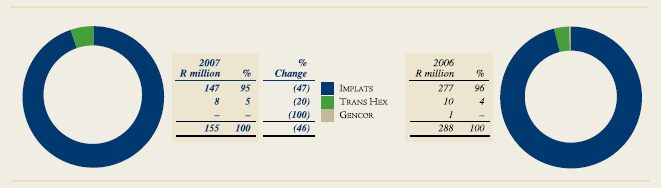
Remgro’s interest in Implats is 4.2% and only dividend income has been accounted for.Trans Hex
Trans Hex Group Limited reported improved profits, but its headline earnings per share decreased by 27%, from 28.2 cents to 21.7 cents.Total rough diamond sales for the financial year decreased by 12% and rand revenue was 5% lower than the prior year. The impact of lower sales volume was partially offset by the weaker rand and marginally higher selling prices. These factors resulted in an earnings per share of 39.4 cents (2006: 112.7 cents earnings per share loss).
CORPORATE FINANCE AND OTHER INTERESTS |
|
|
| 2007 | 2006 | |
| R million | R million | |
| Central treasury | 266 | 146 |
| Net corporate cost | (61) | (56) |
| Pension fund surplus | 70 | – |
| Other interests | 6 | 6 |
| 281 | 96 |
Corporate
The central treasury division’s contribution increased from R146 million to R266 million. This increase can be attributed mainly to higher interest rates as well as higher average cash balances compared to 2006. Also included therein, are foreign currency profits amounting to R65 million (2006: R24 million loss) relating to intergroup balances. These intergroup balances were settled during the past year.The net after-tax corporate costs above, which include salaries, donations and the cost of the share incentive scheme, increased by R5 million, from R56 million in 2006 to R61 million in 2007. Headline earnings was also impacted favourably by the accounting recognition of a pension fund surplus amounting to R70 million following the finalisation of a surplus allocation process.
ACKNOWLEDGEMENT
To all of those who contributed to the performance of the Group over the past year, we extend our sincere thanks: to the shareholders for their continued confidence; the managing directors and all colleagues in the various Group companies for their co-operation and support; all other directors, officials and employees for their dedication and all parties concerned for services rendered.
 |
 |
| Johann Rupert | Thys Visser |
| Stellenbosch | |
| 18 June 2007 |