- Statement of responsibility by board of directors
- Statement by the company secretary
- Audit and Risk Committee Report
- Report of the independent auditor
- Report of the board of directors
- Accounting policies
- Balance sheets
- Income statements
- Statements of changes in equity
- Cash flow statements
- Notes to the annual financial statements
- Annexure A – Principal subsidiary companies
- Annexure B – Principal investments
- Annexure C – Significant associated companies
- Annexure D – Information on business and geographical segments

General report – investment review
(Note: Only limited commentary is given for listed companies seeing that the information is generally available.
The unlisted investments are dealt with in more detail.)
| tobacco interests | ||
| Contribution to headline earnings | ||
| 2009 | 2008 | |
| R million | R million | |
| R&R Holdings | 2 295 | 3 579 |
R&R Holdings
Prior to the unbundling of the investment in British American Tobacco Plc (BAT) during November 2008, Remgro’s interest in BAT was represented by its one-third holding of the ordinary shares and all of the “2005” participation securities issued by R&R. The balance of the ordinary share capital of R&R was held by Compagnie Financière Richemont SA. In addition to the above, Remgro also held one-third of the “2006” participation securities issued by R&R.For the seven months to 31 October 2008 Remgro’s share of R&R’s headline earnings consisted of 35.46% of R&R’s share of the attributable profit of BAT and its share of R&R’s non-BAT income (including income attributable to its investment in the “2006” participation securities referred to above).
| 2009 | 2008 | |
| £ million | £ million | |
| Attributable profit of BAT before non-recurring and capital items | 1 359 | 2 275 |
| R&R’s share of the attributable profit of BAT: | ||
| – 30.06% to 30.20% (2008: 29.62% to 29.97%) | 410 | 679 |
| R&R’s non-BAT income | 10 | 12 |
| R&R’s headline earnings for the year ended 31 March | 420 | 691 |
| Remgro’s share thereof: | ||
| – 35.46% of R&R’s share of the attributable profit of BAT | 145 | 241 |
| – portion of R&R’s non-BAT income | 6 | 10 |
| 151 | 251 | |
| R million | R million | |
| Translated at an average R/£ rate of 15.2235 (2008: 14.2882) | 2 295 | 3 579 |
BAT has a 31 December year-end and reports to its shareholders on a quarterly basis. Additional information in respect of BAT, including copies of the annual and quarterly reports, is available from the BAT website at www.bat.com.
| FINANCIAL SERVICES | ||
| Contribution to headline earnings | ||
| 2009 | 2008 | |
| R million | R million | |
| FirstRand | 815 | 1 090 |
| RMBH | 761 | 1 030 |
| 1 576 | 2 120 |
Both FirstRand Limited (“FirstRand”) and RMB Holdings Limited (“RMBH”) have June year-ends and therefore their results for the twelve months ended 31 December 2008 have been equity accounted in the Remgro results for the period under review.
FirstRand – Listed
FirstRand’s contribution to Remgro’s headline earnings shown in the table above only represents Remgro’s 9.2% direct interest in FirstRand and excludes the indirect contribution from FirstRand through Remgro’s interest in RMBH.FirstRand’s latest results for the six months ended 31 December 2008 reported that headline earnings decreased by 20% to R4 553 million (2007: R5 702 million). Pro forma headline earnings, after taking into account the unbundling of FirstRand’s share in Discovery during November 2007, decreased by 17% to R4 553 million (2007: R5 517 million). These results are reflective of an extremely difficult operating environment, characterised by declines in asset prices, continued market volatility and a deteriorating economic outlook, both locally and internationally.
The earnings of the commercial bank, FNB, decreased by 15%, mainly as a result of a significant increase in the bad debt charge. RMB, the investment bank, had lower earnings by 20% despite a strong performance by its investment banking division. The continued liquidation of the international trading portfolios and the default of Dealstream led to losses of R798 million reported by the Equity Trading division. The earnings of WesBank, the instalment finance business, declined by 62% due to a combination of a higher bad debt charge and slowing book growth in its local lending business. This earnings excludes a loss of R206 million incurred on the sale of the Australia MotorOne advances book. The significant drop in equity markets has led to a 19% decrease in the earnings of Momentum to R740 million (2007: R913 million).
FirstRand believes that the benefits to consumers of reducing interest rates will only start to show in late 2009 or the early part of 2010 and economic activity will remain subdued. Therefore, earnings from its local retail franchises will remain under pressure in the second half of the year.
The local investment and corporate banking activities of FirstRand are expected to remain resilient in the second six months which will mitigate to some extent the strain in the local retail business.
RMBH – Listed
For the six months ended 31 December 2008, 79.6% (2007: 88.9%) of RMBH’s headline earnings, before taking into account other net income and funding costs, was from FirstRand, while its other interests contributed 20.4% (2007: 11.1%). RMBH’s other interests include Discovery Holdings Limited, OUTsurance Limited and RMB Structured Insurance Limited.The Discovery Group is active in the insurance and healthcare funding markets in South Africa and the United Kingdom, and performed exceptionally well. Strong performances from Discovery Health and Discovery Life increased headline earnings by 19% to R489 million for the six months ended 31 December 2008. The short-term insurer, OUTsurance, posted excellent results for the period under review, with net earned premium income exceeding R1.9 billion and reflecting a 19% increase. After allowing for start-up costs of “Youi”, an Australia-based direct insurer, Outsurance reported an
increase in headline earnings for the six-month period by 17% to R331 million (2007: R282 million). RMB Structured Insurance (“RMBSI”) creates individual insurance and financial risk solutions for large corporates by using innovative financial structures. RMBSI’s contribution to RMBH’s headline earnings for the period under review amounted to R25 million and is relatively small compared to the R205 million and R131 million from OUTsurance and Discovery respectively.
RMBH has sold its 12.3% interest in Glenrand M.I.B at the end of December 2008. The gain arising on the sale of Glenrand M.I.B and its contribution to headline earnings for the period under review do not have a material effect on RMBH and are included in its other net income.
Industrial interests
Contribution to headline earnings
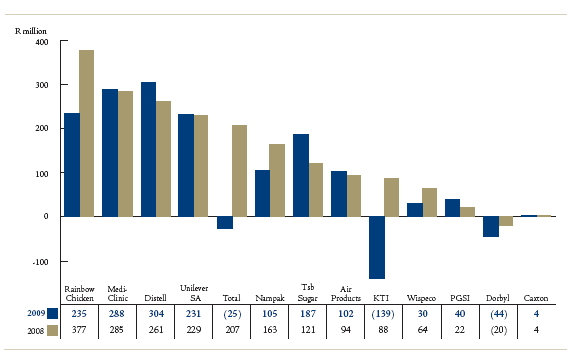
Rainbow Chicken Limited (“Rainbow”) – Listed
For the year ended 31 March 2009, Rainbow’s headline earnings decreased by 39.6% from R528.1 million to R318.8 million, but by only 14.8% if unrealised losses on financial instruments used in the feed raw material procurement strategy are excluded from headline earnings. The decline in headline earnings is mainly a reflection of the 32.2% feed cost increases which could not entirely be recovered by increased chicken pricing.Rainbow’s total revenue increased by 14.4%, underpinned by a 17.2% growth in chicken revenue which contributed 79% of total revenue. Overall chicken sales volumes increased by 2%. Feed raw material prices peaked at historically high levels during the past twelve months and remain exceptionally volatile.
On 30 July 2008, Rainbow’s BEE transaction was concluded with the issue of the 15% shares to the BEE consortium. The only impact of this transaction on Rainbow’s results will be the recurring employee portion of the option charge and STC payable on dividends declared in respect of these shares.
Consumer spending is expected to remain under pressure, given the global economic recession and its spill-over impact locally. Maize prices are likely to remain at the current lower levels, while soya prices are likely to remain under pressure due to lower anticipated crops. By virtue of Rainbow’s forward
procurement policy, feed prices are only expected to be meaningfully lower in the second half of the 2010 financial year. The lower anticipated feed prices and the benefit of the unrealised procurement losses accounted for in 2009 are likely to have a favourable impact on the earnings for the 2010 year.
The Rainbow range of products can be classified as ‘core’ and ‘added value’. Added-value products which now include Rainbow Viennas and Polonies, Rainbow Crumbed as well as Rainbow Grill and Braai, have shown tremendous growth and now contribute a meaningful percentage to retail sales. Rainbow Simply Chicken Polony has become the market leader in the polony sector through the focus on driving growth in the added value portfolio.
Rainbow’s focus on innovation, differentiation and communication continues to prove successful. Rainbow’s brand strategy has been effective in delivering an acceptable margin during a period of extreme input cost pressure.
Medi-Clinic Corporation Limited (“Medi-Clinic”) – Listed
Medi-Clinic’s turnover increased by 71% to R16 351 million (2008: R9 579 million) for the year under review, while headline earnings increased by 3% to R624 million (2008: R608 million). As a result of the Hirslanden acquisition during the second half of 2007/08 and the related financing thereof, the results of Medi-Clinic are not directly comparable to those of the previous period.Medi-Clinic acquired 100% of Hirslanden, the holding company of the largest private hospital group in Switzerland with effect from 26 October 2007. Hirslanden is the leading private hospital group in Switzerland, comprising 13 private acute-care facilities. For the previous financial year, Hirslanden’s revenue included in Medi-Clinic’s results was R3 041 million and operating income before interest, taxation, depreciation and amortisation (“EBITDA”) was R710 million. Hirslanden’s revenue and EBITDA for the year under review amounted to R8 737 million and R1 961 million, respectively.
The Southern African group revenue increased by 12% to R6 792 million (2008: R6 056 million) for the year under review due to a 3.3% increase in bed-days sold and an 8.6% increase in the average income per bed-day. EBITDA increased by 12% to R1 458 million (2008: R1 302 million) despite inflationary pressure during the last six months of the 2008 calendar year, and the Southern African operations contributed R553 million (2008: R527 million) to the attributable income of Medi-Clinic.
Medi-Clinic has a controlling interest (50% plus one share) in Emirates Healthcare Holdings Limited which owns and operates the Welcare Hospital and The City Hospital in Dubai. Emirates Healthcare also has the right to develop another hospital, which will make it the largest healthcare provider in Dubai. Revenue from the United Arab Emirates increased by 71% to R822 million
(2008: R482 million) for the year under review, while EBITDA declined by 76% to R12 million (2008: R50 million), mainly due to start-up losses at The City Hospital.
Distell Group Limited (“Distell”) – Listed
Distell’s financial year-end is 30 June. However, included in Remgro’s headline earnings are the company’s results for the twelve months ended 31 December 2008.Distell reported for the six months ended 31 December 2008 that turnover grew by 21.6% (2007: 12.9%) to R6.1 billion (2007: R5.0 billion) on a sales volume increase of 15.9%. Sales volume in the South African market increased by 10.7% (2007: 5.4%). International sales volume, including Africa, grew by 37.1%, resulting in an increase of 54.3% in international turnover. Turnover derived from Africa delivered exceptional growth, contributing 54.0% to international turnover.
The increase of 19.9% (2007: 17.9%) in Distell’s headline earnings for the six-month period to R650 million (2007: R542 million) was largely due to continued revenue growth and productivity improvements.
Unilever South Africa Holdings (Pty) Limited (“Unilever South Africa”) – Unlisted
Remgro included R231 million (2008: R229 million) of the earnings of Unilever South Africa in its headline earnings for the twelve months ended 31 March 2009. Included in Remgro’s share of Unilever South Africa’s earnings are restructuring costs amounting toR23 million (2008: R19 million).
During the previous financial year, Unilever restructured its South African business by merging the Foods, Ice-cream and Home and Personal care businesses into one legal entity, Unilever South Africa. Remgro has an interest of 25.75% in Unilever South Africa since the restructuring.
The combined turnover for the businesses grew by 24.5% for the year ended 31 March 2009. This growth came predominantly through pricing strategy, as prices were increased substantially in the second half of 2008 to mitigate the impact of rising material costs. Growth was further enhanced by improved product supply due to the non-recurrence of the previous year’s poor stock levels.
The strongest revenue growth came from the Washing powders, Savoury & Dressing (“S&D”), Face care and Deodorant categories. Washing powders’ revenue growth is as a result of improved product supply and price increase during 2009. S&D continued its good performance across its soups range. The Deodorant category marketing drive successfully extended into the first quarter of 2009 which resulted in higher growth. Face care categories showed good growth after improvement of poor service levels in 2008.
The Spreads and Culinary business came under pressure as a result of market softening and competitor activity.
Total South Africa (Pty) Limited (“Total”) – Unlisted
Total’s financial year-end is 31 December and therefore its results for the twelve months ended 31 December 2008 have been included in Remgro’s headline earnings. Total’s contribution to Remgro’s headline earnings for the period under review decreased from a profit of R207 million in the previous year to a loss of R25 million, mainly driven by the significant drop in oil prices.Total reported a loss of R101 million for 2008 compared to a profit of R713 million during the previous year. The loss is mainly due to the significant decrease in oil prices, which resulted in stock writedowns of R622 million for the year. Oil prices were very volatile during 2008, trading at record high levels of $144 per barrel and levels as low as $33 per barrel during the second half of the year.
Total’s sales of main fuels have slightly decreased by 1.5% from the previous year, while retail sales decreased by 3.6%. This is a reflection of the reduced demand as a result of the global economic slowdown towards the end of 2008. The company has maintained the same level of investment in its marketing operations, including the revamping of fuel stations and further health, safety, environment and quality investments at the depots.
Natref, in which Total has an interest of 36%, experienced a better reliability rate compared to 2007, despite unscheduled shutdowns which mainly occurred during the first half of the year. Refining margins were lower as a result of the drop in oil prices and the weakening of the rand against the US dollar.
Increased working capital requirements, due to higher oil prices during the first part of the year, led to an increase of R45 million in financing costs, compared to the previous financial year.
Nampak Limited (“Nampak”) – Listed
Nampak has a September year-end. Nampak’s contribution of R105 million (2008: R163 million) to Remgro’s headline earnings relates to its results for the twelve months to 31 March 2009.For the six months ended 31 March 2009, Nampak reported 14% growth in revenue to R10 091 million (2008: R8 875 million) mainly as a result of the recovery of raw material cost increases through price increases and an improvement in trading activity in the rest of Africa. Sales volumes were flat in South Africa and lower in Europe.
Nampak’s headline earnings for the interim period decreased by 39% to R392 million (2008: R643 million). The decrease was mainly as a result of fair value losses on re-measurement of financial instruments during the current period, compared to fair value gains in the corresponding period of the previous year. The reversal of a tax provision of R103 million during the previous year’s interim period also contributed to higher headline earnings for that period.
Tsb Sugar Holdings (Pty) Limited (“Tsb Sugar”) – Unlisted
Tsb Sugar is primarily involved in cane growing and the production, transport and marketing of refined sugar, brown sugar, animal feed and citrus. The main area of operation is the Nkomazi region in the Mpumalanga Lowveld. Sugar products are sold under the well-established Selati brand. The Selati brand enjoys market leadership in its target markets (Gauteng, Mpumalanga, North Westand Limpopo), while market share in the other geographic areas is increasing. Tsb Sugar’s two sugar mills are situated near Malelane and Komatipoort. Tsb Sugar also holds a 27.4% shareholding in Royal Swaziland Sugar Corporation Limited, a company that owns and operates two sugar mills in Swaziland. In addition, the company holds an effective shareholding of 63.7% in Mananga Sugar Packers, a sugar packaging and marketing company based in Swaziland, which markets sugar under the First brand in Swaziland as well as in South Africa.Headline earnings increased by 55% to R187 million (2008: R121 million) notwithstanding increased cost pressure throughout the value chain. Turnover, driven by an increase in volume and prices, increased by 49% to R3 732 million (2008: R2 509 million). Sugar, citrus and animal feed respectively accounts for 82%, 6% and 8% of turnover (2008: 77%, 9% and 9%).
The South African sugar industry’s production decreased by 0.5% in 2008/09. In comparison, Tsb Sugar’s raw sugar production increased by 16.9%. This was due to the favourable climatic conditions, an increase in cane production yields and the expansion the past few years in the area under cane. During the year under review the Komati mill produced the most sugar of all the mills in the sugar industry, with Malelane mill in the fourth position.
A total of 4.093 million tons of cane were crushed this season (2008: 3.952 million tons), with a record production of 508 473 tons raw sugar (2008: 475 452 tons) at the two mills operated by Tsb Sugar. The cane crushed to raw sugar ratio of 8.04 compares favourably to the South African sugar industry average of 8.49 and indicates good production efficiencies at both mills. Tsb Sugar operates a refinery at the Malelane mill complex, where raw sugar received from the company’s sugar mills is refined for both the local and export markets. The refinery produced 342 489 tons of refined sugar during the year (2008: 333 762 tons).Tsb Sugar’s animal feed operation, Molatek, produces various feed products for the livestock market. The major raw materials (molasses and bagasse) used in the production process are by-products of sugar production. Molatek’s production was at the same level as the previous year despite adverse conditions in the marketplace.
Tsb Sugar is also invested in citrus through its 51% share in Golden Frontiers Citrus (“GFC”). GFC owns three citrus estates where grapefruit and oranges are cultivated, harvested and packed for the export market. The marketing of the citrus is undertaken by Komati Fruits, a partnership between various citrus producers. GFC harvested 43 000 tons of grapefruit and 21 000 tons of oranges. The percentage of total production exported was 70% (2008: 68%). GFC also leases a citrus farm from, and manages banana farms on behalf of, newly established BEE companies.
The settlement of land claims registered on Tsb Sugar’s farms is progressing well, with the Tenbosch land claim finalised during the previous year. Jointly controlled companies to manage transferred land were formed with land claimants. Negotiations regarding the remaining land claims are in the final stages and are expected to be concluded in the coming financial year.
Air Products South Africa (Pty) Limited (“Air Products”) – Unlisted
Air Products has a September year-end. For the twelve months ended 31 March 2009, Air Products’ turnover grew by 13.1% (2008: 15.3%) from R1 006.6 million to R1 138.5 million and Remgro’s share in its headline earnings by 8.3% (2008: 30.5%) from R94 million to R102 million.Air Products is the largest manufacturer in Southern Africa of industrial gases. Air Products also imports and distributes a variety of specialty gases and chemical products that are supplied to a wide range of industries, including steel, chemicals, oil refining, resource minerals, glass, pulp and paper, food packaging as well as general manufacturing, fabrication and welding.
The company operates a number of large-scale plants in Southern Africa, providing cost-effective gas supply solutions to major corporations via pipeline supply or bulk liquid gases delivered by road tankers. A variety of smaller customers are supplied with a wide range of products in cylinders or minitanks. Many of these customers are assisted in the use of these products by innovative technologies supplied by Air Products.
A new air separation plant has been recently commissioned in Newcastle, KwaZulu-Natal, to meet growing demand for gaseous and liquid products in the region.
Kagiso Trust Investments (Pty) Limited (“KTI”) – Unlisted
KTI is a black economic controlled investment holding company. Its investments are predominantly in the financial services, media and mining sectors. Its two largest investments, by value, are its interests in Metropolitan Holdings Limited and Kagiso Media Limited.KTI’s financial year-end is 30 June. However, included in Remgro’s headline earnings is KTI’s results for the twelve months ended
31 December 2008.
KTI posted a headline loss of R332 million for the twelve months ended 31 December 2008, compared to headline earnings of
R211 million in the prior twelve-month period. The headline loss is mainly due to an unfavourable fair value adjustment on the conversion rights attached to its holding of Metropolitan Holdings Limited convertible preference shares as well as a significant drop in the platinum price.
KTI restructured its investment in Alstom, whereby its interest of 22.5% in Alstom SA was disposed of, and acquired 9.5% interest in newly formed Alstom Investment Holdings. The profit on this transaction of R367 million is included in operating profit but not in headline earnings.
Wispeco Holdings Limited (“Wispeco”) – Unlisted
For the twelve months under review, Wispeco’s headline earnings included in Remgro’s results amounted to R30 million(2008: R64 million).
Wispeco’s financial performance was influenced by reducing sales volumes linked to economic downturn and inventory devaluation due to the significant reduction in aluminium prices worldwide. Turnover decreased by 7% on the previous year while inventory devaluation absorbed in the year under review amounted to R39 million.
The building industry represents a prominent market segment for Wispeco’s products and was negatively affected by the credit crunch and global economic slowdown. Although residential building activity reduced markedly, infrastructure development and commercial building activity proved more resilient. During the year under review, Wispeco expanded its capability to service previously untapped extrusion market segments with larger, heavier and technically more challenging products.
Apart from the opening of a new stockist branch in Randburg, the year under review was one of consolidation while increasing the focus on productivity and customer service effectiveness. Wispeco continued to drive the development of technical skills in the industry through its variety of training initiatives.
PGSI Limited (“PGSI”) – Unlisted
PGSI’s financial year-end is 31 December and therefore its results for the twelve months ended 31 December 2008 have been included in Remgro’s headline earnings. PGSI’s contribution to Remgro’s headline earnings for the period under review was R40 million.PGSI, through its wholly owned subsidiary PG Group (Pty) Limited, is the largest flat-glass manufacturer in Africa. Products are supplied to the building and construction, home improvement, furniture, solar energy, new vehicle manufacturing, auto glass replacement and rail industries. The group is also a significant exporter of building and auto glass finished products to Africa, Europe and the USA.
For the year ended 31 December 2008, PGSI reported 2% growth in turnover, and 21.8% growth in headline earnings to R174 million. The results for 2008 include a decrease of the liability for cash-settled equity compensation schemes, driven by lower profits reported at PG Group. Operating profits, excluding any impact of compensation schemes, reduced from R330 million in 2007 to R164 million in 2008, mainly due to the pressure of high inflation, electricity cost escalations and sharp price increases in key raw materials on operating margins.
The results of PG Group were negatively impacted by the difficult macro-economic environment. The electricity crisis earlier in the year, high interest rates and a decline in business confidence domestically and globally significantly impacted demand for PG Group’s products in both the building and automotive industry. The bedding down of the extensive capital investment programme in both its major flat-glass facility in Springs and its three automotive plants also contributed substantially to the lower returns. These implementation problems were substantially resolved by year-end.
The automotive industry has been severely impacted, with passenger vehicle sales decreasing by 24% from the prior year, and downward pricing pressure from international automotive manufacturers in the light of the global economic downturn. The building industry, however, performed better than the previous year due to a number of large construction projects such as airports, football stadiums, office buildings and hotels. The performance of the residential building market was disappointing, impacted mainly by the high interest rate regime. Overall, the building glass market had a sound year, which to some extent offset the negative automotive environment.
Net financing costs were significantly higher than the prior year, as the capital expenditure programmes at PG Group were financed by debt. These programmes are nearing completion and the group will be well invested in new, world-class equipment and capacity which will improve efficiencies and capabilities to service the market as the economy recovers.
Dorbyl Limited (“Dorbyl”) – Listed
For the financial year ended 31 March 2009, Dorbyl contributed headline losses of R44 million (2008: losses of R20 million) to Remgro’s headline earnings.The deterioration in the results for the year under review was mainly due to massive volume reductions and the ongoing negative impact of global price pressures from automotive original equipment manufacturers preventing increased input costs from being fully recoverable.
The group is in the process of implementing various strategic interventions and actions to dispose of or close certain businesses and to dispose of certain properties.
| MINING INTERESTS | ||
| Contribution to headline earnings | ||
| 2009 | 2008 | |
| R million | R million | |
| Implats | 346 | 267 |
| Trans Hex | (182) | (3) |
| 164 | 264 |
Implats Limited (“Implats”) – Listed
Remgro’s interest in Implats is 4.4% and only dividend income has been accounted for. Dividend income of R346 million (2008: R267 million) increased by 30% year on year.Trans Hex Group Limited (“Trans Hex”) – Listed
Trans Hex reported a headline loss of R637 million (2008: R8 million) for the year ended 31 March 2009. The headline loss was primarily due to the impairment of assets relating to its Angolan operations.Trans Hex’s revenue from continuing operations decreased by 28% to R637 million (2008: R881 million) for the year and
losses from continuing operations, before impairments and taxation, amounted to R280 million. South African carat production decreased to 88 933 carats (2008: 107 305 carats), due to lower grades, while diamond prices dropped significantly from September 2008.
The demand for diamonds and the strengthening in prices thereof have improved during the last month of the year under review and Trans Hex anticipates this trend to continue throughout the next financial year. Trans Hex had a net cash position of R205 million
(2008: R194 million) at year-end and costs will be controlled to ensure its sustainability in current market conditions.
| CORPORATE finance and other interests | ||
| Contribution to headline earnings | ||
| 2009 | 2008 | |
| R million | R million | |
| Central treasury | 144 | 180 |
| Foreign currency profits | 50 | – |
| Net corporate costs | (807) | (56) |
| STC on dividend in specie | (686) |
– |
| Share scheme costs – non-recurring costs | (33) |
– |
| Other | (88) |
(56) |
| Other interests | (80) | 9 |
| Business Partners | 28 |
47 |
| Xiocom | (108) |
(38) |
 |
|
|
| (693) | 133 |
Corporate finance
The central treasury division’s contribution to headline earnings decreased from R180 million to R144 million. Lower interest rates than in the comparative year resulted in lower interest income being earned. Foreign currency profits amounting to R50 million were realised on the repatriation of R&R dividends (2008: RNil).The net after-tax corporate costs, which include salaries, donations and the cost of the share incentive schemes, increased by
R751 million, from R56 million in 2008 to R807 million in 2009. This increase can be attributed mainly to secondary taxation on companies (STC) amounting to R686 million payable on the dividend in specie.
Other interests
Other interests’ contribution decreased from a profit of R9 million in 2008 to a loss of R80 million for the year under review. This decrease can be attributed mainly to losses amounting to R108 million which were equity accounted from the investment in Xiocom (2008: R38 million loss for eight months of the year).Business Partners Limited (“Business Partners”) – Unlisted
Business Partners is a specialist investment group, providing risk finance, mentorship and property management services to small and medium enterprises in South Africa.Headline earnings for the twelve months ended 31 March 2009 amounted to R129.8 million (2008: R213.1 million), representing a decrease of 39.1% compared to the previous year. Headline earnings attributable to Remgro for the period was R28 million
(2008: R47 million). The decrease in headline earnings is primarily due to the negative impact of the decline in the macro-economic environment over the past twelve months on the small business sector. The operating income has thus been negatively impacted by increases in bad debts and provisions for bad debts.
Xiocom Wireless, Inc. (“Xiocom”) – Unlisted
Xiocom is a global provider of integrated wireless broadband solutions to network operators in underserved markets. Xiocom offers a range of flexible, market-driven services that substantially reduces the cost to design, deploy and manage broadband wireless networks.The company made good progress in its first full year of operations. The major events were:
- Setting up of Main Street Broadband, a company that obtained a $34 million low interest rate, non-recourse loan from a government agency to roll out 66 networks in the rural areas of South Georgia and North Florida in the USA
- Establishing a joint venture, Xiotel, in the Dominican Republic to deploy a wireless network for which the building of the infrastructure has commenced
- Acquisition of a wireless network in Madison City, USA
The business was re-organised and re-focused to take account of the current economic environment. Both Main Street Broadband and Xiotel will be operational during the course of the next financial year.
acknowledgement
To all of those who contributed to the performance of the Group over the past year, we extend our sincere thanks to: the shareholders for their continued confidence; the managing directors and all colleagues in the various Group companies for their co-operation and support; all other directors, officials and employees for their dedication and all parties concerned for services rendered. |
 |
| Johann Rupert | Thys Visser |
| Stellenbosch | |
| 22 June 2009 |